Saturday, November 21, 2015

D.O.A. (1950)

http://www.imdb.com/title/tt0042369/?ref_=nv_sr_4


*** out of 5

"I don't think you fully understand, Bigelow. You've been murdered!"

I stated at the beginning of the month that my plan for Noirvember was to watch chronologically a series of film noir films that were entirely new to me.  This one is a cheat, but I wanted to include it in my schedule this year because it's been many years since I saw it last, and having recently purchased it on DVD, I wanted to see it again.  So sue me.  It's a personal and sentimental favorite, for the reason that it was one of my first introductions into the world of noir.  Seeing it again so many years later it has been an interesting experience.

This is, bluntly, a bizarre oddity.

The story itself makes little logical sense, but to try to apply logic is to miss the point.  D.O.A. is an exercise in nightmare storytelling and dream logic. This is a world where seemingly everyone is against one man, with little apparent reason, and even less explanation.

Rudolph Mate, like Ted Tetzlaff, is a cinematographer-cum-director.  His work here is wild, and you can sense that cinematographer's eye at work in the moody lighting, startling close-ups, and evocative use of angles to establish emotional effects.  Things like use of a superimposed whirlpool shot during a crossfaded transition to take us into the flashback show the direction of someone with a eye for visual storytelling. It is also edited lean and mean- with not a frame of spare footage, and time compressed and improbably condensed.  Watch the aggressive use of cuts to give a sense of manic energy to the scenes in the nightclub where the main character gets poisoned.

Dimitri Tiompkin's score is also a strange brew- from the punchy opening sequence, to Inner Sanctum-esque organ stings to evocative violins.  The nonsensically weird slide-whistle sound effects, which are thrown into the soundtrack as O'Brien's character does some girl-watching in hotel where a raucus party is going on, seem cartoonish and out-of-place, but if we think of this as someone's nightmare, they make perfect sense-  in a dream or a nightmare, absurdity is commonplace and even logical.  That seemingly logical reality in a dream is part of what makes them so frightening.

Similarly terrifying is the sequence after he discovered he's been lethally poisoned.  He wanders the streets aimlessly, like James Mason in Odd Man Out, watching  the dance of life go on without him- a child playing with a ball, a young couple embracing on the street in from on him.

In many ways, this plays like a pastiche of the great noir moments, all bundled together in one monstrous nightmare.  Other, more "realist" noirs seem to always have a reason for their hero's woes, but here, it all comes down to an insane misunderstanding, a whim of fate- the sort of thing that we begin to see more and more of as the noir cycle continues.

I'm not even going to attempt to explain the plot, or all the characters' relationships to one another.  As I say, this is a dream world, where everything connects, and none of it makes any sense.   Take for example the relationship between O'Brien's character, Bigelow, and his faithful secretary, Paula (Pamela Britton) When first introduced she comes across as almost needy and controlling - giving a sense that O'Brien is trapped and smothered by her attentions, and needing to get away from her for a while.  Then you see that he is so tethered to her that he can't help calling her daily, even while he's girl-watching on his vacation.  But who is it that he ends up relying on when everyhing goes down the drain?  You guessed it.  as in a dream, she morphs into an idealized companion, the perfect girl he never knew he always loved.

Or watch how quickly O'Brien shifts his characterization from the gentle, soft-spoken and shy businessman to one who is first terrified, filled with despair, then finally so hardboiled by his lack of anything left to lose that he can stare down the barrel of a gun, take repeated hits to his agonized stomach, then turn and punch the man in the face while he's holding the gun and beating him with it.

There are femme fatales everywhere in this dream world, and unreasonable betrayals by friends and strangers alike. There are conniving underworld bosses like Luther Adler's Majak character, and wild-eyed psychpaths like Neville Brand's Chester, a creepy henchman who, like Albert Dekker's character Armitage in the 1950 film Destination Murder (which came out within months of this), speaks of himself in the third person as he takes O'Brien on a ride to try to kill him someplace private.

Finally, in keeping with that dream-world sense the story has so thoroughly established,the ending that finally comes is as sudden and shocking as waking from a nightmare.  His story told, O'Brien drops dead in the police headquarters, and is pronounced dramatically to be "Dead On Arrival."


Night and the City (1950)

http://www.imdb.com/title/tt0042788/?ref_=fn_al_tt_1


***** out of 5

"Night and the city.  The night is tonight, tomorrow, or any night.  The city is London."

The opening narration sets the tone for everything to follow, but only hints a the depths of richness to follow.  Nobody wins in this city.  and yet for all their cruelty and greed, you find youtself caring for these lowlifes and sorry for them in their inescapable, pathetic misery.

Jules Dassin directed this film, the last one he made for Hollywood before leaving to work in Europe in the wake of the McCarthy era blacklisting period. Despite his inability to exercise editorial control over the final fim because of that blacklisting, he left an indelible image that is one of the absolute best noir masterpieces I've seen yet.

The film has two different scores (and two different edits) - one American version and one English.  I watch the american version, for which Franz Waxman provided a score that is alternately haunting, heartbreaking, pulse-pounding, and electrifying. Jo Eisinger, who previously adapted Gilda for the screen, provides the screenplay here, working from a Gerald Kersh novel. Dassin claimed that he never read it until much later, and was surprised how different they were. Kersh also reportedly hated how his book was handled. Time and the collective response of cinema-goers has shown any criticism on that front to be a moot point.

The story was set and shot in London.  It stars Richard Widmark as Harry Fabian, a small-time grifter - a loser on the make, desperate to "be somebody." He has a long string of failed money making schemes leading up to this point in his life.  Th fatal scheme he seizes on finally involved working every possible angle against a whole spectrum of unsavory character in a bid to become successful as a wrestling promoter.

Gene Tierney plays his loyal girl, Mary Bristol a club singer girl who wants to marry and settle down with him, putting up with all his plotting and planning but begging with him to give them up and earn his way in a more honest, humble, and reliable job.

Hugh Marlowe may make the least dramatic contribution to the story as Adam Dunn, the downstairs nice-guy neighbor who casually plays a rival for Tierney's affections, and functioning conveniently as a plot point as a pivotal moment in the story.

Pulling him in the opposite direction of Tierney is Googie Withers, in a powerful performance as Helen Nosseross, who, with her husband Philip Nosseross, owns the club where Harry and Mary work. nights.  She is a clear Femme Fatale type, eager to leave her husband and be her own woman, by hook or crook.

Francis L Sullivan is also terrific as Philip Nosseross, playing him as scheming, sly, and jealously protective of his wife, as ultimate deperately needy for her. He sees Widmark as a threat, but plays him along in his Promoter scheme, in order to serve his own ends.

Herbert Lom, who is best known for his role as the bumbling police chief in the Pink Panther, here plays a much different role.  He is Kristos, the big man in town, a deadly menace who is territorial of his position a the most powerful fight promoter in town, who is nonetheless also a loving and loyal son to his kindly father, a retired Greco-Roman wrestler who objects to the cheap entertainment-style wrestling he promotes.

Stanislaus Zbuszko is the most astonishing surprise of the film as Gregorius, the great wrestler and father of Kristos and Nicholas, a young wrestler who follows his father's desires to be a "real" wrestler.  His performance is an impressively physical and emotional powerhouse of acting, particularly in the dramatic encounter with The Strangler (Mike Mazurki), a pro wrestling big-shot full of ego and anger.  That scene is, dramatically speaking, the fulcrum on which the entire story pivots from a good noir to an all-time great. The way each of the character respond to it makes the full consequences of Harry's scheming come into clear focus, and the stakes of the story raised to a visceral, palpable, tangible a matter of life-and-death.

I'm tempted to name 1950 the year of the dead hero. In this year, we have D.O.A., Sunset Boulevard, Panic in the Streets, and Night and the City.  DOA is narrated by a man who is dying of poisoning.  Sunset Bouelevard opens famously with the narrative voice of a man whose corpese we see floatin in the water.  Panic in the Streets follows Jack Palance fleeing police with a deady disease coursing through his veins. Can Night and the City be included in that company?  Maybe it;s a stretch, since Widmark doesn't really get killed until the climax, but on a symbolic level, he's been dead from the beginning, only he foesn't know it until it's too late.

The film starts and ends with Widmark on the run, scrambling across London on foot, dodging people he owes money or who otherwise want him dead. "All my life I've been running," he realizes in a late moment of reflection in the film. Hiding on a little boat by the warf with an old lady named Anne, Widmark finds his one moment of rest in the film. He reflects on a life of wasted time and effort spent chasing the wrong things, and blindly abusing the one person who loved him. Even his one selfless act is still just another final harebrained scheme, one that involves giving up his own life to get a bit of money for Mary.

Undertow (1949)

http://www.imdb.com/title/tt0042007/?ref_=fn_al_tt_7


** out of 5

"Big Jim used to call me his watchdog.  They got him when I wasn't here, but I'll get that guy someday.  I'll get him."

William Castle directs this decent B-noir that stars Scott Brady, the younger, slightly less cold-edged brother of noir great Lawrence Tierney.  Brady plays a former gambler and soldier who's planning to go straight with a legitimate business of his own, but who get caught up in an underworld plot he can't seem to escape.  John Russell plays his casino-running old friend, and Dorothy Hart is the fiancee of Brady's character.  When Brady comes into Chicago to pay his friend a visit a murder is committed, and he is made to look like the perpetrator.
The victim is "Big Jim," father of Dorthy Hart's character, and a major figure in local circles.  Brady flees for his life, aided by a girl he met on the plane to Chicago from Reno, played by Peggy Dow.  He searches for others who can help clear him, including a cop who he grew up with, played by Bruce Bennett.
The drama that follows is entertaining, though slight. The filmmaking for the most part lacks the intensity and emotional connection that the best noirs acheive.  It does offer some moments of memorable situation, but the characters rarely rise above being simple 1-dimensional "types."
There is a dark moment when Brady realized that those closest to him are responsible for his betrayal, but the filmmakers fail to take advantage of the full dramatic possibilities of the situations they have set up in the plot.
One other memorable aspect of the story is "Gene," a big black man (Daniel Ferniel) who worked for Big Jim in his garage.  He is an interesting blend of dogged loyalty, innocence, and dangerous violence. He poses a deadly threat for whoever is responsible for Big Jim's death, but his reasons are completely relateable, and ultimately his character is a sympathetic one.  He is like a lumbering angel of death, vowing to kill the one responsible for Jim's murder, which, in the final moments of blended pathos and suspense, he does with great feeling and drama.


Rope of Sand (1949)

http://www.imdb.com/title/tt0041822/?ref_=fn_al_tt_1


*** out of 5

"the pain won't go away until I get what I already paid for!"

IMDB's brief summary is pretty accurate: "A man[Burt Lancaster] abused by a sadistic mining company cop [Paul Henreid] before he could tell where on their desert property he'd found diamonds decides to steal them instead."

The plot is essentially that, but where the filmmakers go with that plot is interesting and engaging.  Add to that plot a cast of colorful characters that includes Claude Raines, Peter Lorre, Sam Jaffe, and Mike Mazurki, and the results should be pretty entertaining, right?  

In some ways, it feels like an attempt to recapture the magic of Casablanca.  We have the African setting, three of the key players from that film, and a complicated romance between Burt Lancaster and Corinne Calvet as a substitute for Bogie and Ingrid.  Call it Casablanca lite if you like, But it is really its own creature.  The relationships and characters are too different for a direct comparison. 

The love triangle of Casablanca, for example, is only dimly reflected here.  Claude Raines is the conniving, casually larcenous man who hires Calvet to try to play Henreid against Lancaster to help Raines get the diamonds all to himself.  While Henreid does express desire for Calvet, he is spurned for his sadism and cruelty, and never seriously considered a likely object of her affections, but merely a trap for her to try to escape with Lancaster's help. Some reviewers have complained that Calvet "is no Ingrid Bergman," but she is a very good Corinne Calvet, and seeing what she does so well in this film, one wonders why anybody would want her to be someone other than who she is. Not only is she a stunningly beautiful figure (strikingly appareled by the incomparable Edith Head), she is an effective and moving actress in a difficult role as a hired femme fatale with a complicated past who, falling for the man she is supposed to be betraying, ultimately becomes a part of his and her own redemption.

Paul Henreid plays a socially ambitious man, Commandant Vogel, who is also complexly nuanced- is sadistic, but with a near-fetishistic attraction for works of art- paintings, pottery, diamonds, and women, none of which his more brutal attributes will allow him to keep.  His relations with all the other characters is a strained dichotomy: on one hand wanting respect and love, and on the other enjoying the brutal exercise of the power he has fought so hard to obtain.

Peter Lorre is also in the film, as a talkative, philosophizing small-timer of the type that is an odd melding of his role in Casablanca with that of Sidney Greenstreet in Maltese Falcon.  Unfortunately he is given far too little to do, and the character has minimal reason for existing in the story, as a mere plot device for helping accomplish Lancaster's goals.

As I began watching this Southern Africa-based film noir, I couldn't help but ponder the historical-political state of the place where it was set, as it might relate to the story.  Where the action takes place is not specifically explained in great detail, but various clues are present that can give a general sense of the locale.  The [fictionalized?] location of most of the action is a small desert town called Diamontstad, which, with its Germanic-sounding name, combined with references in the dialogue to Cape Town, and the points at which the border with Angola become important to the plot, all suggest that this takes place in the then-disputed territory of South-West Africa (modern-day Namibia), which was previously under control of Germany before WWII, and over which South Africa was then disputing with UN for control.  

The time when this film came out was 1949, roughly a year after the first steps toward institution of Apartheid policies were being implemented in South Africa.  I knew that much going into the film and wondered what, if any, part that might play in the storytelling.  This film ultimately isn't about that at all, though.  However, there are numerous instances in which it touches on issues of race.  The opening scene depicts a black man being chased through the desert by half-tracks driven by diamond cartel thugs with guns protecting their territory from intruders.  That opening is meant to set up the stakes and the main threat of the film, but it also shows the mindset of the villains toward the native Africans- that they are little better than animals to be hunted down and killed without impunity. Following this up is scene of perhaps a more cruel and bureaucratic abuse:  Paul Henreid is seen shortly afterward, negotiating a labor contract with 3 local chiefs, and laying out conditions of their employment through a translator:
"You sign up for a year. No drinking"
"Wives?"
"Once a month."

Race also plays into the introduction of Burt Lancaster's character. We first see a boat man shouting orders to those unloading his hold, and getting resistance to his demands.  A very human reaction is depicted by Kenny Washington's character, a black laborer who pretends not to understand the man's English as a way of refusing to do what he wants. When he is injured by Henreid shortly after, and defended by Lancaster, he utters a soft "thank you." to him.  "I thought you didn't speak English." Lancaster says in surprise.  Washington replies, "I don't speak English much, to many people." Lancaster and the audience both say, "I see what you mean." 

The film depicts of Washington gratefully responding to Lancaster's act of kindness by going to work for him.  Some modern viewers may consider this as "perpetuating slave-master racial relations," or make some similar academic response.  But within the context of this film, it is a small but sincere effort to change perceptions of race by contrasting the humanity of this  man with the inhuman brutality of Henreid and calculating cruelty of Raines.  That, really is the heart of the film.  Yes, it's an entertaining noir, with riveting moments of drama like the vicious fistfight that takes place during a sandstorm, but it's ultimately most effective as a look at the dark side of what it means to be human- to care about others, and how quickly greed and cruelty can corrupt and destroy that humanity.

Wednesday, November 18, 2015

The Clay Pigeon (1949)

http://www.imdb.com/title/tt0041252/?ref_=fn_al_tt_5


*** out of 5

This is an early Richard Fleischer film, from a story by Carl Foreman (probably most well known today for High Noon), and it has everything you could ask for in a film noir- A coma, amnesia, WWII veterans, conspiratorial underworld organizations, and a police manhunt for the wrong man. Plus you get bizarre bonuses like the unlikely choice of a gang leader who is also a former Japanese prison guard (Richard Loo).

Still, the racial portrait painted in this film is actually a fairly nuanced one. Balancing the brutal portrayal of the Japanese prison guard, nicknamed "The Weasel," we have a brief nod to the valor of Japanese Americans who fought and died in the war. (though no mention of internment, if that's what you're looking for).

Bill Williams stars as the veteran in question, freshly awakened from a coma, with partial amnesia, and a looming courtmarshal for crimes he doesn't remember.  Barbara Hale is the wife of his fellow prison-camp inmate and pal who he is accused of betraying.
Richard Quine is the third piece in two triangles- He is the third musketeer of the prisoners, and the third major player in the film's plot.  Is he just a friend eager to help Williams acquit himself and find the real villains? Or does is he carefully maneuvering to hide ulterior motives?

Not everything makes sense here, but things move along pretty briskly, and there are a number of interesting twists in the plot that help to maintain the audience's sense of unease and concern for the hero and his friends.  Fleischer's best work is ahead of him, but he is well in command of his medium already here.

The Window (1949)

http://www.imdb.com/title/tt0042046/?ref_=fn_al_tt_1


*** out of 5

"You gotta believe me!  Somebody's gotta believe me!"

Let's play a round of Zero Degrees to Alfred Hitchcock!

This film is directed by Ted Tetzlaff, the cinematographer for Hitchcock's masterpiece Notorious.
The screenplay was by Mel Dinelli (who did a handful of notable noir films [Spiral Staircase, Beware My Lovely, Cause for Alarm, Jeopardy], but mostly wrote for television, including 1 episode of Alfred Hitchcock Presents).  It was based on The Boy Who Cried Murder, a short story by Cornell Woolrich, who also wrote the story that inspired Hitchcock's masterful Rear Window(note the thematic similarites in title and theme). Roy Webb, who composed the score, also worked on Notorious.

And how does all this Hitchcocky influence affect the final results? Pretty well. Hitchcock famously remarked that he destroyed the tension by making the mistake of letting the bomb go off in Sabotage, killing the boy who carried it. Spoiler- the boy doesn't blow up here, and the tension is mighty palpable.

Bobby Driscoll, a major child star on loan from the Disney studios, is the star of this tale-  a little boy who likes to make up stories to spice up his pretty drab daily life. The opening scenes effectively present a potent juxtaposition between the boy's vividly imaginative fantasies and the real world of rotten, crumbling condemned city buildings among which he and his friends play and live.

Late on night, Driscoll goes out on the fire escape to sleep where it is cooler, and witnesses his upstaur neighbors (Paul Stewart and Ruth Roman) kill a man in their apartment. Their motives are never explained, a good example of how well the film depicts the story largely from a child's perspective.

Barbara Hale and Arthur Kennedy are his beleaguered but well-meaning parents, who, like the people in the Aesop's fable of the Boy Who Cried Wolf, refuse to accept that his tale of murder is anything more than a nightmare or another of his wild stories.  He persists at attempting to persuade them he is telling the truth, but only get himself into trouble, shut in his room and otherwise punished and pushed aside.

The moment when his parents leave him home alone in the apartment with the killers plotting to come and silence him may be one of the scariest in noir. Like all the great antiheroes (we can call him that since his previous tales are partly to blame for his current position), he is left to face the world and fate alone.  The way he manages to excape shows the kind of toughness that only the strongest of the great noir characters exhibit, yet in the end it is clear he is still really just a frightened child trying to survive evils he is not meant to know, making the crescendo of tension all the more dramatic, and its climax so shocking.

Watch for repeated window imagery:
1) The introductory shot of the child is looking through an open window, down at his friends below, a perfect symbol of isolation.
2) When he is sent to his room for telling stories-  the bars of the fire escape communicate that he is trapped in this situation
3) the murder scene is viewed through a window, from the outside looking in.
4) When Driscoll's cries for help are finally heard after the climax is over, as lights come on and neighbors are seen looking out the windows with concern, before calling rescue squads in the end the danger Driscoll faces.

Tuesday, November 17, 2015

Picking up the Themes in Noir Titles

Looking down lists of film Noir titles, you can't help noticing certain repeated themes,

I thought I'd  organize a list that put some of them together under common attributes. I know there are a ton that I've missed, so please feel free to add to this listing in the comments, with titles I've overlooked, & I'll insert them into the post!


Kisses/Acts of Love Blended with violence:

Kiss of Death
A Kiss Before Dying
Kiss me Deadly
The Naked Kiss
Kiss the Blood Off My Hands
Kid Glove Killer
Strange Love of Martha Ivers
Murder My Sweet
Touch of Evil
Bond of Fear
Other Love
The Deadly Game


Houses/Buildings
House of Strangers
House by the River
House on Telegraph Hill
House on 92nd Street
The House on Carroll Street
House of Bamboo
The Red House
5 Against the House
Road House
House Across the Street
Home to Danger
Shack Out on 101
Stranger on the Third Floor
Behind Locked Doors
Secret Beyond the Door
Knock on Any Door
The Shadow on the Window
Shadow on the Wall
Woman in the Window
The Window
High Wall
The Glass Wall
The Walls Came Tumbling Down
The Spiral Staircase
The Glass Key
Union Station
Grand Central Murder
Riot in cell Block 11
Women's Prison
Big House, U.S.A.
Crashout
Escape From San Quentin


Phone Numbers
Call Northside 777
Southside 1-1000
99 River Street
Dial 1119
Dial M for Murder
Call it Murder
Sorry, Wrong Number
Phone Call From a Stranger


Streets

13 Rue Madeleine
Scarlet Street
The House on 92nd Street
23 Paces to Baker Street
99 River Street
Race Street
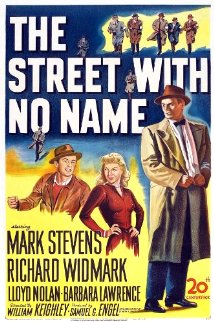
Street With No Name
Mystery Steet
Side Street
Terror Street
Panic in the Streets
Crime in the Streets
Stakeout on Dope Street
The House on Carroll Street
House Across the Street
Sunset Boulevard
Mulholland Drive
Madison Avenue
Just off Broadway
Nightmare Alley
the Naked Road
Plunder Road
Road House
Roadblock
Shack Out on 101
They Drive by Night
Drive a Crooked Road
Walk a crooked Mile
The Crooked Way
Walk East on Beacon
The Fiend Who Walked West
Walk Softly, Stranger
I Walk Alone
He Walked By Night
Detour
U-Turn
Breakdown
The Hitchhiker
Where the Sidewalk Ends
The Asphalt Jungle
Girl on the Bridge
Across the Bridge
The Last Mile
Hot Cars
The Woman on Pier 13
Pier 23
Down 3 dark streets


Cities/Locations
City of Fear
Dark City
Night and the City
While the City Sleeps
City That Never Sleeps
The City Without Men
Cry of the City
The Captive City
Roaring City
Whispering City
Atomic City
Casablanca
The Man From Cairo
Passage to Marseille
Hollywood Story
The Phenix City Story
The Las Vegas Story
The Miami Story
The Houston Story
Shanghai Story
The Tijuana Story
Portland Expose
Chicago Deadline
Chicago Confidential
Kansas City Confidential
New York Confidential
The Killer That Stalked New York
Two Men in Manhattan
The Case Against Brooklyn
Niagara
Berlin Express
Tokyo Joe
Key Largo
Malaya
Macao
Affair in Trinidad
The Kremlin Letter
Chinatown
Brighton Rock
49th Parallel
Lure of the Wilderness
World For Ransom
The Man on the Eiffel Tower
In a Lonely Place
Mexican Manhunt
Mystery in Mexico


Crime
Crime Wave
Scene of the Crime
Crime in the Streets
Crime and Punishment
Appointment with Crime
Illegal
Homicide
The Killing
Born to Kill
Shoot to Kill
Paid to Kill
The Name of the Game is Kill
Killing of a Chinese Bookie
Appointment with Murder
Murder by Contract
Murder My Sweet
Murder is My Beat
A Blueprint for Murder
Anatomy of a Murder
Witness to Murder
Destination Murder
Grand Central Murder
Rx Murder
Murder Can Be Deadly
Please Murder Me
Murder, Inc.
Shield for Murder
Arson, Inc.
Act of Violence
Violent Saturday
The Big Steal
Plunder Road
Armored Car Robbery
The Conspirators
The Racket
The Mob
The Big Operator
Hoodlum Empire
The Lineup
The Underworld Story
Vice Raid
Crashout
Escape From San Quentin


Criminals
Criminal Lawyer
The Prowler
The Burgler
The Strangler
The Assasin
The Sniper
The Slasher
The Killer That Stalked New York
Kid Glove Killer
The Killers
The Killer is Loose
The Hoodlum
The Bigamist
Loan shark
Killing of a Chinese Bookie


Guns/Weapons
This Gun For Hire
Gun Crazy
My Gun is Quick
Point Blank
A Bullet for Joey
Backfire
Crossfire
Shoot to Kill
The Sniper
The Big Knife
The Weapon


Time
Out of the Past
The Big Clock
Two O'Clock Courage
Split Second
The Reckless Moment
Appointment with Crime
Appointment With Danger
Appointment with Murder
Fourteen Hours
Too Late For Tears
The Dark Hour
The Desperate Hours
Hell's Five Hoirs
The October Man


Margins/Deadlines
Below the Deadline
Deadline at Dawn
Chicago Deadline
The Narrow Margin
Deadline USA
Edge of Doom
Edge of Darkness


Personal Possessives
Murder My Sweet
Kiss the Blood Off My Hands
Farewell My Lovely
Sleep, My Love
My Son John
Murder is My Beat
My Gun is Quick
My Name is Julia Ross
His Kind of Woman
No Man of Her Own


Light and Dark
The Dark Corner
Man in the Dark
Dark Passage
Down 3 Dark Streets
The Dark Mirror
The Dark Hour
So Dark the Night
They Met in the Dark
Dark Waters
Spin a Dark Web
Pit of Darkness
Blackout
The Long Night
They Live By Night
Night and the City
Somewhere in the Night
All Through the Night
Clash By Night
Twilight Women
Night Must Fall
Nightfall
Night People
Fear in the Night
He Walked By Night
The Night Holds Terror
Sunset Boulevard
Between Midnight and Dawn
Deadline at Dawn
Tomorrow is Another Day
Nocturne
Escape in the Fog
Shadow Man
The Shadow on the Window
Shadow on the Wall
Moontide
Moonrise
Gaslight
Inferno


Colors
Black Angel
Black Widow
Black Narcissus
Portrait in Black
The Black Book
Blackout
The Black Glove
The Green Glove
Green For Danger
Slightly Scarlet
Scarlet Street
The Red House
Red Light
The Red Menace
The Blue Dahlia
The Blue Gardenia
Pete Kelly's Blues
Devil in a Blue Dress
Ride the Pink Horse
Blonde Ice
Bad Blonde
Flaxy Martin
Golden Salamander


Good And Evil
Bad For Each Other
Born to Be Bad
The Bad and the Beautiful
Bad Blonde
Force of Evil
Touch of Evil
Diabolique
Notorious
Ruthless
Johnny Angel
Fallen Angel
Black Angel
Angel Face
Beat the Devil
Devil in a Blue Dress
Private Hell 36
Hell Bound
Hell's Five Hours
Hell's Half Acre
Inferno
Damned
Leave Her To Heaven
Body and Soul
Actors and sin
The Seventh Commandment
The Unholy Four
The Tall Lie


Crooked
The Crooked Web
Drive a Crooked Road
Walk a crooked Mile
The Crooked Way


Life and Death
You Only Live Once
Nobody Lives Forever
Where Danger Lives
They Live By Night
Easy Living
Something to Live For
Condemned to Live
A Race for Life
A Life at Stake
Hangmen Also Die
Kiss of Death
a Kiss Before Dying
Death in Small Doses
Death of a Scoundrel
I Died a Thousand Times
Dead Reckoning
D.O.A.
The Big Sleep
The Glass Tomb


Nudity/Trasparency
Over-Exposed
The Glass Wall
The Glass Tomb
The Naked Kiss
the Naked Road
The Naked Alibi
The Shadow on the Window
Woman in the Window
The Window


Confessions and Secrets
One Girl's Confession
Confessions of a Nazi Spy
I Confess
Secret Beyond the Door
A Woman's Secret
Open Secret
Hidden Fear
Shield For Murder
Foreign Intrigue
Whispering City
Kansas City Confidential
New York Confidential
High School Confidential
Chicago Confidential
Portland Expose
No Questions Asked


Fear
Ministry of Fear
The Wages of Fear
Sudden Fear
Hidden Fear
The Fearmakers
Cape Fear
Storm Fear
Fear in the Night
Stark Fear
Bond of Fear
Fear No More
Reign of Terror
Experiment in Terror
Study in Terror
Panic in the Streets
Terror Street
The Night Holds Terror
I Wake up Screaming
Shock
Tension
Two O'Clock Courage
The Defiant Ones
Crack-up
The Breaking Point


Danger
Background to Danger
Appointment With Danger
Cry Danger
Five Steps to Danger
Where Danger Lives
Green For Danger
Home to Danger
Danger Zone
Wings of Danger
A Dangerous Profession
Dangerous Crossing
on Dangerous Ground
Experiment Perilous
The Red Menace
Storm Warning
Kiss Me Deadly
Murder Can Be Deadly
The Deadly Game


The Clutches of Fate
Spellbound
Snowbound
Cornered
Caught
Captive City
Trapped
Man-Trap
The Trap
Lure of the Wilderness
Man Bait
Pit of Darkness
Convicted
Tight Spot
Pressure Point
No Way Out
Damned
Caged
Pitfall
Undertow
Whirlpool
Quicksand
Snowbound
Bond of Fear
Hell Bound
Raw Deal
Hi-jacked
Loophole
Escape in the Fog
Desperate
Pursued
Backlash
Recoil
Track the Man Down
Mexican Manhunt
Woman on the Run
The Big Chase
the Hunted
The Girl Hunters


Mistaken Guilt/Identity
Above Suspicion
The Unsuspected
Betrayed
Decoy
Strange Impersonation
Stolen Face
The Verdict
Beyond a Reasonable Doubt
They Made me a Fugitive
The Fugitive
The Wrong Man
Fall Guy
Fallguy
Framed
The Scapegoat
Railroaded
The Marked One
Cover-Up
The Set-Up
Fingerprints Don't Lie
Circumstantial Evidence
Pushover


Occupations
A Dangerous Profession
Tough Assignment
Night Editor
The Bodyguard
The Enforcer
The Postman Always Rings Twice
T-Men
FBI Girl
The Bunco Squad
Counterspy
Counterspy Meets Scotland Yard
Scotland Yard Inpector
Radar Secret Service
Motor Patrol
Western Pacific Agent
The Undercover Man
Detective Story
Mary Ryan, Detective
Gumshoe
Hangmen Also Die
Mr District Attorney
Criminal Lawyer
The Case of the Baby-Sitter
Actors and Sin
Paid to Kill


Money/Desired Objects/MacGuffins
Contraband
Maltese Falcon
Mask of Dimitrios
The Locket
The Brasher Doubloon
The Bribe
The Wages of Fear
I'll Get You
Treasure of Monte Cristo
The Golden Salamander


Character Names
Gilda
Miss Sadie Thompson
Rebecca
Laura
Vicki
Daisy Kenyon
All About Eve
The Two Mrs. Carrolls
The Strange Love of Martha Ivers
The File on Thelma Jordan
My Name is Julia Ross
Mary Ryan, Detective
Captain Carey, USA
Dillinger
David Harding
Johnny Eager
Johnny O'Clock
Johnny Angel
Johnny Allegro
My Son John
A Bullet For Joey
Tokyo Joe
Mr Arkadin
Rififi
Marlowe
Two Jakes
Pete Kelly's Blues
Rise and Fall of Legs Diamond
Flaxy Martin
The Strange Affair of Uncle Harry
The Great Flamarion
Amazing Mr. X
Meet Mr. Callaghan
Bobby Ware is Missing


Crying
I Wake Up Screaming
Cry Danger
Cry Vengeance
Cry of the City
Too Late For Tears


Temperature
The Big Heat
Heat Wave
Blonde Ice


Strangers
House of Strangers
Strangers in the Night
Stranger on the Third Floor
The Stranger
Walk Softly, Stranger
Stranger on the Prowl
Phone Call From a Stranger
Don't Gamble With Strangers
Three Strangers
The Strange One
The Strange Woman
Strange Impersonation
Odd Man Out
The Strange Affair of Uncle Harry


Men and Women
The Man Who Knew Too Much
Odd Man Out
The Third Man
Man in the Dark
The Man I Love
The Man With a Cloak
Man in the Attic
Track the Man Down
The Man From Cairo
Shadow Man
The Man on th Eiffel Tower
Manhunt
Man-Trap
Man Bait
Limping Man
No Man of Her Own
The 49th Man
Two Men in Manhattan
The City Without Men
The October Man
T-Men
No Man's Woman
His Kind of Woman
Woman in the Window
The Strange Woman
The Second Woman
Woman on Pier 13
Twilight Women
Phantom Lady
Lady in the Lake
Lady From Shanghai
Lady Gangster
The Lady Gambles
The Gambler and the Lady
A Lady Without a Passport
The Lady in Question
Dishonoured Lady
Forever Female
The Girl Hunters
Girl on the Run
The Girl on the Bridge
FBI Girl


Cards/Gambling
Two of a Kind
Ace in the Hole
5 Against the House
Four Deuces
The Lady Gambles
The Gambler and the Lady
Don't Gamble With Strangers
Raw Deal
Odds Against Tomorrow
The Big Combo
 Killing of a Chinese Bookie


Big Things
Big House, U.S.A.
The Big Steal
The Big Operator
The Big Knife
The Big Clock
The Big Sleep
The Big Chase
The Big Heat
The Big Combo